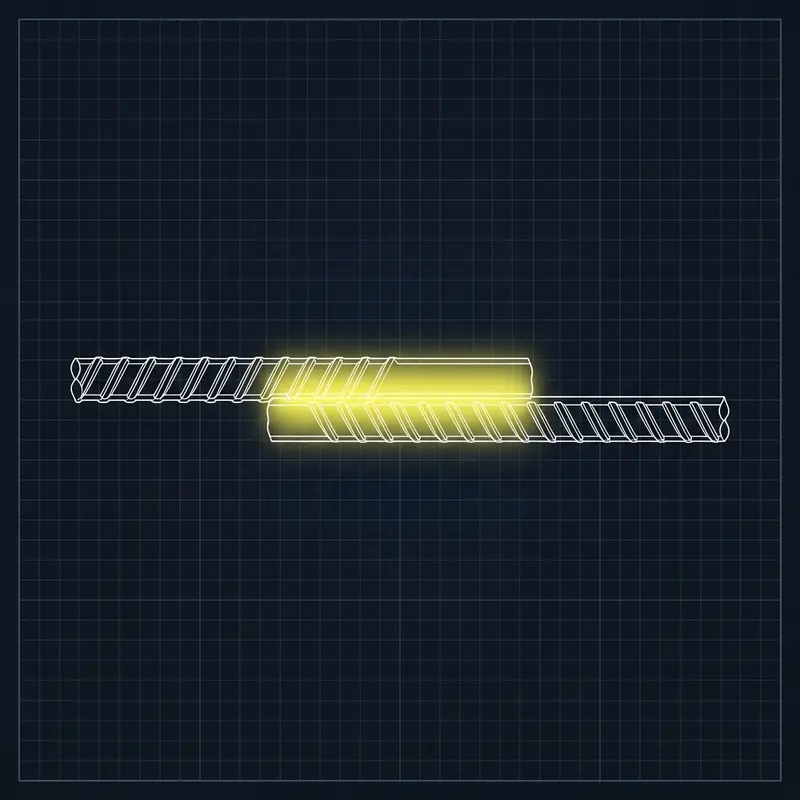
In reinforced concrete construction, it is impossible to use continuous bars for the entire length of large structures. Rebars must be spliced together to maintain structural continuity. The two critical concepts governing this force transfer are Development Length (Ld) and Lap Length.
Loading diagram…
This guide details the calculations and code provisions based on IS 456:2000.
1. Development Length (Ld)
Development length is the minimum length of embedment required for a reinforcing bar to develop its full design strength in concrete. It ensures that the bar will yield before it slips or pulls out of the concrete.
The IS 456 Formula (Clause 26.2.1)
Ld = (∅ × σs) / (4 × τbd)
Where:
- ∅ = Nominal diameter of the bar (mm)
- σs = Stress in the bar at the section considered at design load (For Fe500, σs = 0.87 × 500 = 435 N/mm²)
- τbd = Design bond stress (given in IS 456 Table 21 for different concrete grades).
Important Modifiers for Bond Stress (τbd)
The values of τbd in Table 21 are for plain bars in tension. IS 456 mandates modifications:
- Deformed Bars (TMT): Increase τbd by 60%.
- Bars in Compression: Increase τbd by 25%.
Example Calculation for Ld
Calculate Ld for a 20 mm Fe500 bar in tension, using M30 concrete.
- From IS 456 Table 21, τbd for M30 = 1.5 N/mm².
- Modify for deformed bar: τbd = 1.5 × 1.6 = 2.4 N/mm².
- σs = 0.87 × 500 = 435 N/mm².
- Ld = (20 × 435) / (4 × 2.4) = 8700 / 9.6 = 906.25 mm (approx. 45 × ∅).
2. Lap Length
When a bar ends, the stresses must be transferred to a continuing bar. The overlap provided is called the Lap Length.
Tension Lap Splices (Clause 26.2.5.1)
The lap length including anchorage value of hooks for bars in bending tension shall be:
- Ld or 30∅, whichever is greater.
For bars in direct tension (like in a tie member):
- 2 × Ld or 30∅, whichever is greater.
Compression Lap Splices (Clause 26.2.5.2)
The lap length in compression shall be equal to the development length in compression, calculated but not less than 24∅.
- Lap Length (Compression) = Ld (compression) or 24∅, whichever is greater.
Different Diameter Splices
When two bars of different diameters are spliced together, the lap length is calculated based on the smaller diameter bar (Clause 26.2.5.1).
Common Mistakes on Site
- Lapping at High Stress Zones: Lapping bars at the center of a beam (max bending moment) or the base of a column (high moment). IS 456 strongly recommends staggering splices and placing them in zones of minimum stress (e.g., L/4 or L/3 distance from supports).
- Ignoring the 60% Increase: Forgetting to increase the bond stress for TMT deformed bars, resulting in excessively long and uneconomical development lengths.
- Insufficient Concrete Cover: Lap splices require adequate concrete cover to prevent the concrete from splitting due to the bursting forces generated during stress transfer.
- No Staggering: Lapping all bars at the same cross-section. IS 456 requires that not more than 50% of the bars should be spliced at one section.
Try the Lap & Development Length Calculator
Apply what you learned — run your own numbers with our free, IS-Code compliant calculator.