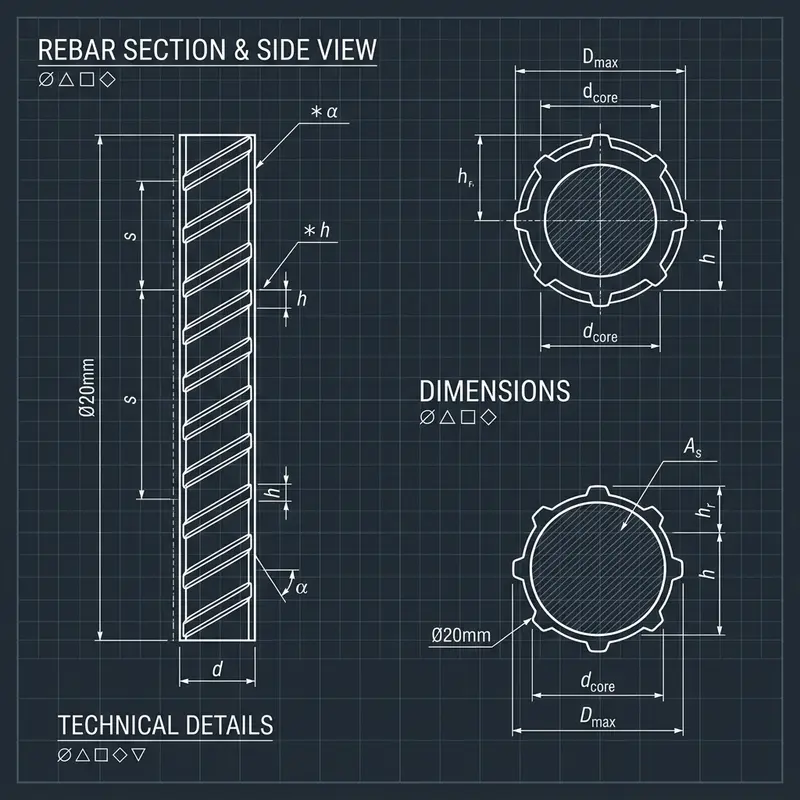
Estimating the exact weight of steel reinforcement (rebar) on a construction site is one of the most frequent tasks for site engineers and quantity surveyors. Relying on approximations can lead to significant cost overruns and material shortages.
Loading diagram…
This guide explains the standard formula to calculate the unit weight of steel per meter, strictly following the nominal mass provisions of IS 1786:2008.
The Universal Formula: D²/162
For circular steel bars, the universally accepted formula for calculating the weight per linear meter (in kg/m) is:
Weight (kg/m) = D² / 162.28
Where:
- D = Diameter of the rebar in millimeters (mm)
- 162.28 = A constant derived from the density of steel (7850 kg/m³) and geometric conversion factors. (Often rounded to 162 for rapid site calculations).
Derivation of the Constant (162.28)
Understanding where this constant comes from is crucial for professional engineers:
- Volume of 1 meter of bar = Cross-sectional Area × Length = (π × D² / 4) × 1000 mm
- Density of Steel = 7850 kg/m³ = 0.00785 kg/cm³ = 0.00000785 kg/mm³
- Weight = Volume × Density = [(π × D²) / 4] × 1000 × 0.00000785
- Simplifying this gives: D² × 0.0061654
- Representing this as a fraction: D² / (1 / 0.0061654) = D² / 162.19 (Standardized to 162.28 in some metric adaptations, but 162 is the site standard).
IS 1786 Nominal Mass Reference
IS 1786:2008 (High Strength Deformed Steel Bars and Wires for Concrete Reinforcement) provides a table of nominal mass for standard bar diameters. Your calculations must align with these values within acceptable tolerance limits.
| Bar Diameter (mm) | Nominal Mass (kg/m) | Allowed Tolerance |
|---|---|---|
| 6 mm | 0.222 kg/m | ± 7% |
| 8 mm | 0.395 kg/m | ± 7% |
| 10 mm | 0.617 kg/m | ± 7% |
| 12 mm | 0.888 kg/m | ± 5% |
| 16 mm | 1.578 kg/m | ± 5% |
| 20 mm | 2.466 kg/m | ± 3% |
| 25 mm | 3.853 kg/m | ± 3% |
| 32 mm | 6.313 kg/m | ± 3% |
[!NOTE] Reference: IS 1786:2008, Table 1 (Nominal Cross-Sectional Area and Mass). Always verify rolling tolerances on site by weighing random sample cuts, as mills often roll slightly "light" or "heavy" within the allowable percentage.
Step-by-Step Site Calculation
Example: You have received a bundle of 16 mm diameter TMT bars. The bundle contains 50 bars, and the standard length of each bar is 12 meters. Calculate the total weight.
- Find Unit Weight: W = 16² / 162 = 256 / 162 = 1.58 kg/m
- Find Weight of One Bar: 1.58 kg/m × 12 m = 18.96 kg
- Find Total Weight: 18.96 kg × 50 bars = 948 kg (or 0.948 Metric Tons)
Common Mistakes to Avoid
- Ignoring Rolling Margins: Using the exact theoretical weight for billing when the actual rolled weight is at the lower limit of the IS code tolerance. Always base final billing on actual weighbridge tickets or agreed rolling margin tests.
- Wrong Constant: Using 162 for imperial measurements (feet/inches). The D²/162 formula is strictly for D in mm and Weight in kg/m. (For kg/ft, the formula is D²/533).
- Neglecting Wastage: Theoretical calculations don't account for cut-pieces (offcuts). Always add an appropriate wastage factor (typically 3-5%) during procurement planning.
Try the Steel Weight Calculator
Apply what you learned — run your own numbers with our free, IS-Code compliant calculator.