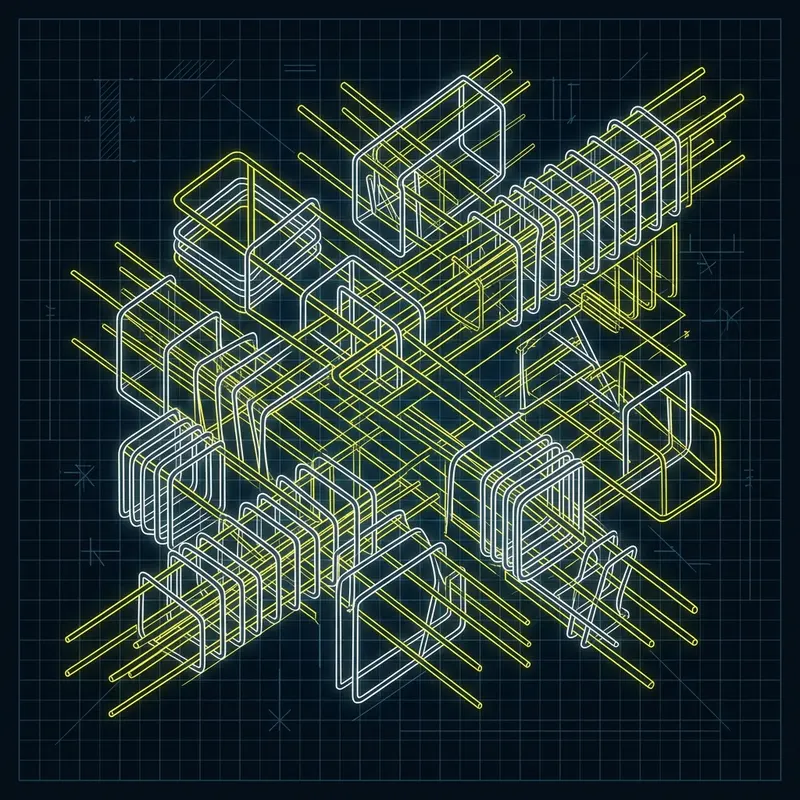
A Bar Bending Schedule (BBS) is a comprehensive list detailing the location, mark, type, size, length, number, and bending details of each bar or fabric in a reinforcement drawing. Preparing an accurate BBS prevents material wastage and ensures structural integrity.
Loading diagram…
This guide covers the fundamental calculations for preparing a BBS, guided by IS 2502:1963 (Code of Practice for Bending and Fixing of Bars for Concrete Reinforcement).
Why Deduct for Bends?
When a steel bar is bent, the material on the outer face stretches, and the material on the inner face compresses. The neutral axis remains unchanged, but practically, the overall length of the bar increases.
If you do not deduct this elongation from your initial cutting length, the final bent shape will be too large, leading to cover violations or failure to fit within the formwork.
Standard Bend Deductions
For different angles of bending, IS 2502 specifies standard deductions based on the bar diameter (d):
- 45° Bend: Deduct 1d
- 90° Bend: Deduct 2d
- 135° Bend: Deduct 3d
- 180° Bend (U-hook): Deduct 4d
[!IMPORTANT] Where 'd' is the nominal diameter of the reinforcement bar.
Standard Hook and Bend Lengths
Anchorage at the ends of bars is often achieved using hooks or bends.
- Standard Hook (180°): The anchorage value is taken as 16d. The length of the straight portion beyond the semi-circular bend is 4d or 50mm, whichever is greater.
- Standard 90° Bend: The anchorage value is 8d. The straight portion beyond the bend should be at least 4d.
- Seismic Hooks (135°): For stirrups and ties in earthquake-resistant design (IS 13920), the hook length should be 10d or 75mm, whichever is greater.
Calculating Cutting Length: Step-by-Step
Let's calculate the cutting length for a rectangular stirrup (column tie) with 135° seismic hooks.
Given:
- Column size: 300 mm x 450 mm
- Clear Cover: 40 mm
- Bar Diameter (d): 8 mm
- Hook Angle: 135° (requires 10d hook length)
Step 1: Calculate the outer dimensions of the stirrup (A & B)
- A = Column Width - (2 × Cover) = 300 - (2 × 40) = 220 mm
- B = Column Depth - (2 × Cover) = 450 - (2 × 40) = 370 mm
Step 2: Calculate the perimeter (Unadjusted Length)
- Perimeter = 2 × (A + B) = 2 × (220 + 370) = 1180 mm
Step 3: Add Hook Lengths
- We have two 135° hooks. Length = 2 × 10d = 2 × 10 × 8 = 160 mm
Step 4: Subtract Bend Deductions
- A rectangular stirrup has three 90° bends and two 135° bends.
- Deduction = (3 × 2d) + (2 × 3d) = 6d + 6d = 12d
- Total Deduction = 12 × 8 = 96 mm
Step 5: Final Cutting Length Formula
- Cutting Length = Perimeter + Hooks - Bend Deductions
- Cutting Length = 1180 + 160 - 96 = 1244 mm (or 1.244 m)
Common Mistakes on Site
- Ignoring Bend Deductions: Simply adding the dimensions together without subtracting the elongation leads to oversized cages.
- Wrong Hook Lengths: Using 90° hooks for stirrups in seismic zones instead of the mandatory 135° hooks (IS 13920).
- Measuring from Inner Edge: BBS dimensions (A, B) should typically refer to the outer to outer dimensions of the bent bar, not the center-line or inner edge, unless specified otherwise.
Try the BBS Calculator
Apply what you learned — run your own numbers with our free, IS-Code compliant calculator.