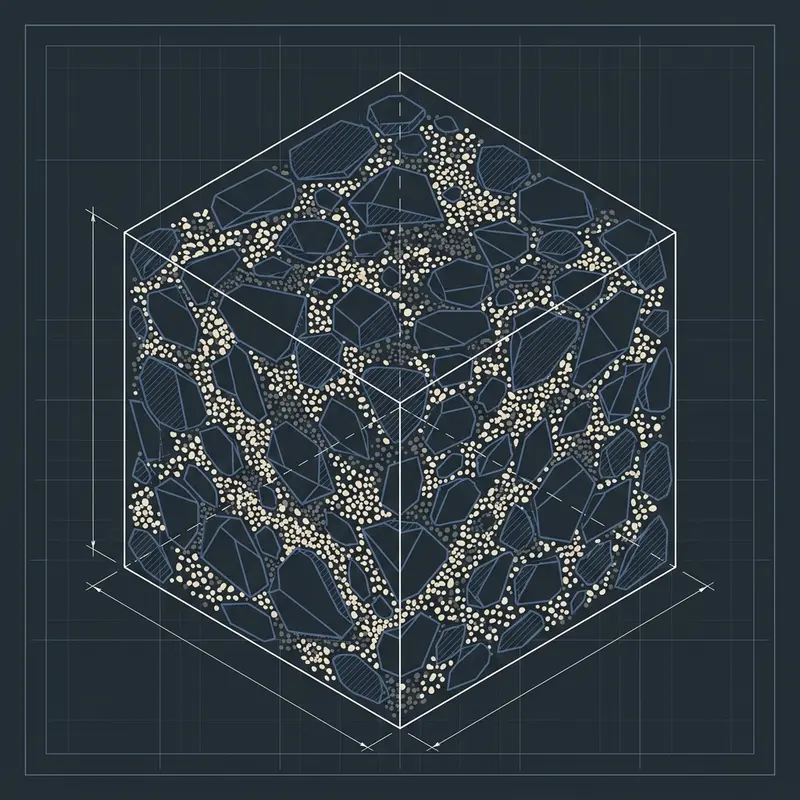
Concrete Mix Design is the scientific method of selecting suitable ingredients (cement, aggregates, water, and admixtures) and determining their relative quantities with the objective of producing concrete of the required strength, durability, and workability as economically as possible.
In India, the standard procedure is governed by IS 10262:2019 (Concrete Mix Proportioning - Guidelines) along with the durability requirements of IS 456:2000.
Loading diagram…
The Absolute Volume Method
The IS 10262 approach relies on the Absolute Volume Method. The fundamental principle is that the absolute volume of fully compacted concrete is equal to the sum of the absolute volumes of all its ingredients.
Volume of Concrete (1 m³) = Vol(Cement) + Vol(Water) + Vol(Aggregates) + Vol(Admixture) + Entrapped Air
Step 1: Target Mean Strength
The mix must be designed for a target mean compressive strength ($f'{ck}$) higher than the characteristic strength ($f{ck}$) to account for statistical variations.
- $f'{ck} = f{ck} + (1.65 × S)$
- (Where S is the standard deviation from IS 10262 Table 2).
Step 2: Selection of Water-Cement (w/c) Ratio
The free water-cement ratio is selected based on the desired target strength and checked against the maximum w/c ratio permitted for durability (IS 456 Table 5 for environmental exposure conditions). The lower of the two values is adopted.
Step 3: Selection of Water Content
The maximum water content per cubic meter of concrete is determined based on the nominal maximum size of aggregate (Table 4 of IS 10262).
- E.g., for 20mm aggregate, max water = 186 liters.
- This value can be reduced if superplasticizers (chemical admixtures) are used.
Step 4: Calculation of Cementitious Material Content
- Cement Content = Water Content / (w/c ratio)
- Check this calculated value against the minimum cement content required for durability (IS 456 Table 5). The greater of the two is adopted.
Step 5: Proportion of Coarse and Fine Aggregate
The volume of coarse aggregate per unit volume of total aggregate depends on the nominal maximum size of coarse aggregate and the grading zone of the fine aggregate (sand) (Table 5 of IS 10262).
- The remaining volume is fine aggregate.
Step 6: Mix Calculations (The Formula)
Assuming 1 m³ of concrete and 1% entrapped air (Vol = 0.99 m³ for solid materials):
- Vol. of Cement ($V_c$) = (Mass of Cement / Specific Gravity of Cement) × (1 / 1000)
- Vol. of Water ($V_w$) = (Mass of Water / Specific Gravity of Water) × (1 / 1000)
- Vol. of Admixture ($V_a$) = (Mass / Specific Gravity) × (1 / 1000)
- Vol. of All Aggregates ($V_{agg}$) = 0.99 - ($V_c + V_w + V_a$)
Now, split $V_{agg}$ into Coarse and Fine based on the ratio determined in Step 5:
- Mass of Coarse Aggregate = $V_{agg}$ × % of Coarse × Specific Gravity of CA × 1000
- Mass of Fine Aggregate = $V_{agg}$ × % of Fine × Specific Gravity of FA × 1000
Example Mix Proportion (M25)
A typical calculated result for an M25 grade concrete per 1 m³ might look like:
- Cement: 380 kg
- Water: 190 Liters (w/c = 0.50)
- Fine Aggregate (Sand): 710 kg
- Coarse Aggregate (20mm & 10mm): 1150 kg
- Ratio by weight: 1 : 1.86 : 3.02
Common Mistakes on Site
- Ignoring Moisture Content: Failing to correct the added water amount based on the existing surface moisture in sand and aggregates. This drastically alters the w/c ratio and reduces strength.
- Assuming Constant Specific Gravity: Specific gravity of aggregates varies by quarry. Using textbook values instead of lab-tested values for the specific source leads to incorrect volume calculations.
- Skipping Trial Mixes: Theoretical calculations are just the starting point. The mix must be validated through physical trial batches to verify workability and 28-day strength before large-scale pouring.
Try the Mix Design Calculator
Apply what you learned — run your own numbers with our free, IS-Code compliant calculator.