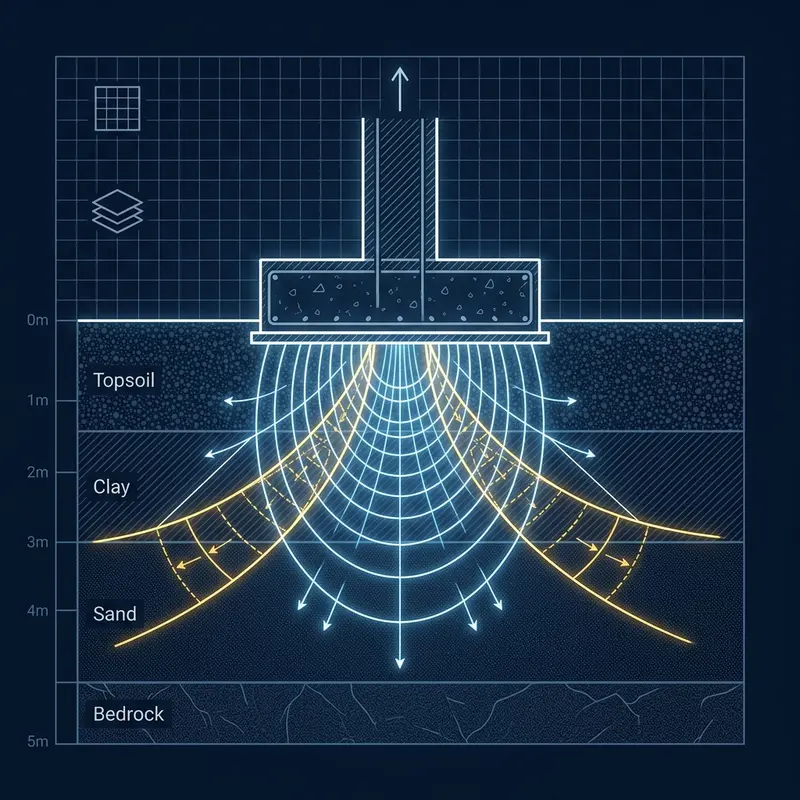
The Bearing Capacity of soil is the maximum load per unit area that the soil can support without failing in shear or undergoing excessive settlement. For structural engineers designing shallow foundations (like isolated or strip footings), calculating the accurate Safe Bearing Capacity (SBC) is the critical first step.
In India, the primary code for this is IS 6403:1981 (Code of Practice for Determination of Bearing Capacity of Shallow Foundations).
Loading diagram…
Ultimate vs. Net Safe vs. Safe Bearing Capacity
- Ultimate Bearing Capacity ($q_u$): The maximum gross pressure at the base of the foundation at which the soil fails in shear.
- Net Ultimate Bearing Capacity ($q_{nu}$): $q_{nu} = q_u - q$ (where $q$ is the effective surcharge at the base level, $q = \gamma \times D_f$).
- Net Safe Bearing Capacity ($q_{ns}$): $q_{ns} = q_{nu} / F.S.$ (where F.S. is the Factor of Safety, typically 2.5 to 3.0).
- Safe Bearing Capacity (SBC or $q_s$): $q_s = q_{ns} + q$. This is the value used to size the footing area.
The General Bearing Capacity Equation (IS 6403)
IS 6403 adopts the general bearing capacity equation (based on Vesic and Meyerhof):
$q_{nu} = c N_c s_c d_c i_c + q (N_q - 1) s_q d_q i_q + 0.5 B \gamma N_\gamma s_\gamma d_\gamma i_\gamma W'$
Where:
- $c$ = Cohesion of soil
- $q$ = Effective surcharge at the base of footing ($q = \gamma D_f$)
- $B$ = Width of the footing
- $\gamma$ = Unit weight of soil
- $N_c, N_q, N_\gamma$ = Bearing capacity factors (dependent on the angle of internal friction, $\phi$)
- $s, d, i$ = Shape, Depth, and Inclination factors
- $W'$ = Water table correction factor
Step-by-Step Calculation
1. Determine Soil Parameters ($c, \phi, \gamma$)
These must be obtained from a geotechnical investigation report (soil test).
2. Find Bearing Capacity Factors ($N_c, N_q, N_\gamma$)
Read these from Table 1 of IS 6403 based on the $\phi$ value.
- Note: If local shear failure is expected (e.g., in loose sands or soft clays), use modified values: $c' = 2/3 c$ and $\tan\phi' = 2/3 \tan\phi$.
3. Calculate Shape Factors ($s_c, s_q, s_\gamma$)
These account for the 3D shape of the footing (Square, Rectangular, Circular).
- For a Rectangular footing (Width $B$, Length $L$):
- $s_c = 1 + 0.2 (B/L)$
- $s_q = 1 + 0.2 (B/L)$
- $s_\gamma = 1 - 0.4 (B/L)$
4. Calculate Depth Factors ($d_c, d_q, d_\gamma$)
Accounts for the shearing resistance of the soil above the base of the footing.
- $d_c = 1 + 0.2 (D_f / B) \sqrt{N_\phi}$
- $d_q = d_\gamma = 1$ (for $\phi < 10°$)
- $d_q = d_\gamma = 1 + 0.1 (D_f / B) \sqrt{N_\phi}$ (for $\phi > 10°$)
- (Where $N_\phi = \tan^2(45 + \phi/2)$)
5. Water Table Correction ($W'$)
If the water table is at or above the base of the footing, the effective unit weight of the soil is reduced (approaching submerged unit weight).
- If Water Table is at ground level: $W' = 0.5$
- If Water Table is at a depth $\ge (D_f + B)$: $W' = 1.0$
- Interpolate for intermediate positions.
Common Mistakes on Site
- Ignoring Water Table Fluctuations: Designing for a dry state when the water table might rise to ground level during monsoons. This can halve the actual bearing capacity, leading to settlement or failure.
- Confusing Net Safe and Safe Bearing Capacity: Sizing a footing using $q_{ns}$ instead of $q_s$ (which includes the surcharge weight of the soil backfill).
- Applying Depth Factors in Deep Trenches: Depth factors assume the soil above the footing provides shear resistance. If the footing is in a wide excavation or on a slope, depth factors should be taken as 1.0.
Try the Bearing Capacity Calculator
Apply what you learned — run your own numbers with our free, IS-Code compliant calculator.